Noomiclone Tricks: The Shapes You Can Hold in the Air
The Nine Moves the Game Names
- Tuck
- Knees to chest. The tightest shape available, and the one that brings a rotation round fastest.
- Pike
- Fold at the hips with the legs straight. Longer than a tuck, so the spin is slower but the landing reach is greater.
- Arch
- The back opens and the body lengthens. This is the shape held on the bar, and the one that lets a swing keep its momentum.
- Layout
- Straight body, no fold. The slowest rotation of the four shapes, and the easiest to read in the air.
- Squat
- Hips down with the knees bent. It reads as a landing shape more than a flight shape.
- Twist
- Rotation around the body's long axis, and the listing allows it in either direction. It is what turns a straight flight into a turning one.
- Flash Kick
- A fast backward leg drive out of the swing. The move that adds height late rather than early.
- Stuck Landing
- A landing with no rebound. In a course of boxes and ramps it is how a run continues instead of ending.
- Bar Regrab
- Catching the next bar with both hands. It is the only thing the browser build counts.
Trick Dictionary
Tuck
Pulled in at the top of the swing, it shortens the arc and lands you early. The safest shape if the next bar looks close.
Pike
A half-fold that keeps some length. Use it when a tuck would over-rotate but a layout would not turn enough.
Arch
Held on the bar and kept through the bottom of the swing. Released too early, an arch turns a long swing into a flat one.
Layout
The readable shape: straight, slow, predictable. Good for learning where the bar actually is before adding rotation.
Squat
Bent knees, hips down. It belongs to the landing half of a course, where the goal is to stop rather than to travel.
Twist
A turn around the long axis. It does not add distance; it changes which way the body faces when the bar arrives.
Flash Kick
A late backward drive. It buys height after the release has already happened, which is the opposite of what a tuck does.
Stuck Landing
No rebound, no step. On the tumbling side this is the whole objective; on the bar side it is what a catch looks like.
Bar Regrab
The catch itself: both hands on the next bar. Every string below exists to make this happen once more.
Arch → Regrab
The plain swing catch. Long arc, late release, no shape change in the air. The baseline every other string is measured against.
Tuck → Regrab
Short arc, early release, catch while still folded. The fastest way to reach a bar that is close and low.
Layout → Regrab
Straight through the flight and open at the catch. Slow rotation makes the timing forgiving, and the reach is honest.
Pike → Regrab
A middle path: enough fold to turn, enough length to reach. Good when the gap sits between a tuck catch and a layout catch.
Twist → Regrab
A turn on the way out, then the catch. The body arrives facing a different direction, so the hands have to lead.
Flash Kick → Regrab
Height added after the release, then the catch. It buys time in the air at the cost of a harder read on the landing.
Squat → Stuck Landing
The tumbling finish: absorb the landing with bent knees and no rebound, so the run continues into the next obstacle.
Tuck → Twist → Regrab
Fast rotation plus a turn. The tightest way to arrive at a bar that is both close and off to one side.
Layout → Twist → Regrab
A slow, readable flight with one turn in it. The shape to practise when the twist keeps arriving too late.
Pike → Flash Kick → Regrab
Length first, height second, catch third. A string for the long gaps where the bar sits above the release point.
Arch → Squat → Stuck Landing
The bar-to-ground finish. Open through the swing, then fold into a landing that stops rather than bounces.
Double Twist → Regrab
Two turns in one flight. It only fits a long swing: with anything less, the second turn arrives after the bar has gone.
What Actually Scores
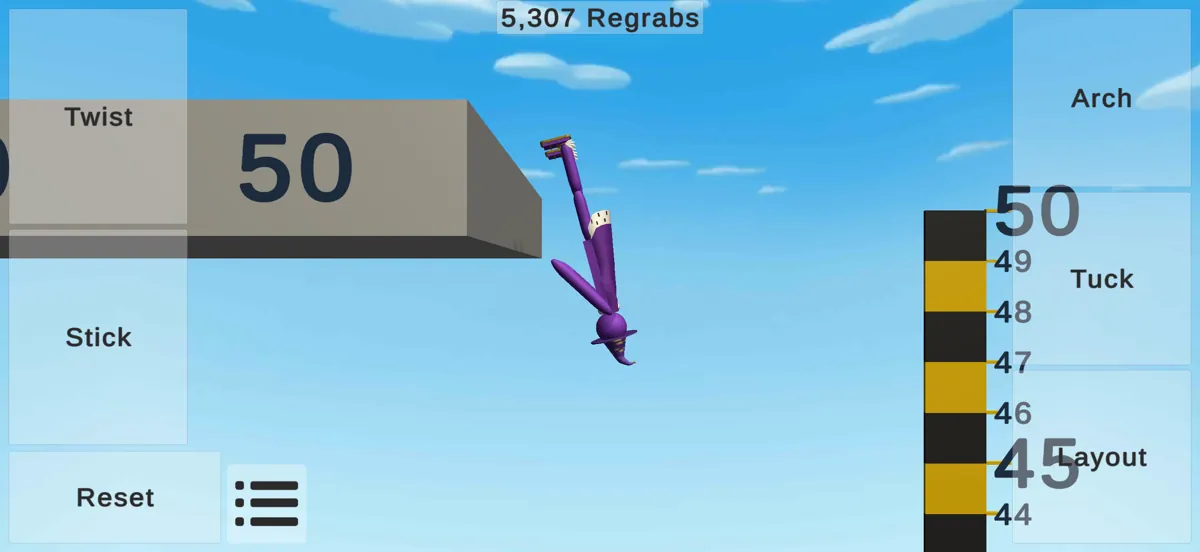
Noomiclone does not award points per trick, and no official listing claims it does. The counter at the top of the browser build climbs by one each time a bar is caught, and that is the entire record of a run. The screenshots the developer publishes show runs sitting at zero, fifteen and one hundred and thirty-nine regrabs, which is the same counter at three different moments.
A deduction is just as blunt: a missed bar ends the attempt. There is no partial credit for a good shape, no bonus for a twist, and no penalty score to carry into the next try. The only thing a trick can do is change whether the catch happens.
That is why the dictionary above is arranged by shape rather than by difficulty. A move is worth exactly what it does to the landing, and nothing more.
Why the Shape Changes the Spin
A body in the air keeps the rotation it left the bar with, and pulling the mass closer to the centre of that rotation makes it turn faster. A tuck does exactly that; a layout does the opposite and lets the turn come round slowly. This is the same trade a gymnast makes on a real bar, and the game reproduces it closely enough that the shape is a control in its own right.
The practical consequence is that tuck is a timing tool, not a speed button. Tucked too early, the rotation finishes before the bar arrives; tucked too late, it finishes after the body has already dropped. The useful moment is the top of the swing, where the change still has time to matter.
A Practice Order That Works
- 1
Hold the arch
One session of nothing but arching through the bottom of the swing. Learn how long the bar keeps carrying you after the lowest point. (Arch)
- 2
Release with no shape change
Catch the next bar with the body still open. Until this lands repeatedly, every other string is guesswork. (Arch → Let go)
- 3
Add one tuck
Introduce the fold at the top and watch the landing move earlier. Then take the tuck out again and feel the difference. (Arch → Tuck → Let go)
- 4
Add one twist
A turn on a slow shape, so the arrival direction is visible rather than guessed. Practise one direction before the other. (Arch → Layout → Twist → Let go)
- 5
String them under pressure
Only now combine. The goal is not a long combo but a repeatable one: three catches in a row beats one clever flight. (Arch → Tuck → Twist → Let go)
Where to Go Next
The controls page covers the four keys and the input strings these moves are built from; the map overview explains what the single browser scene contains and how the mobile courses differ. Neither page repeats this dictionary, and this one does not repeat them.